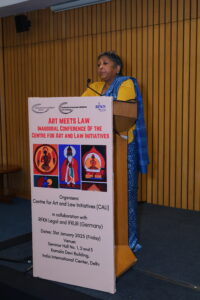
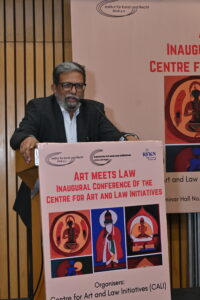
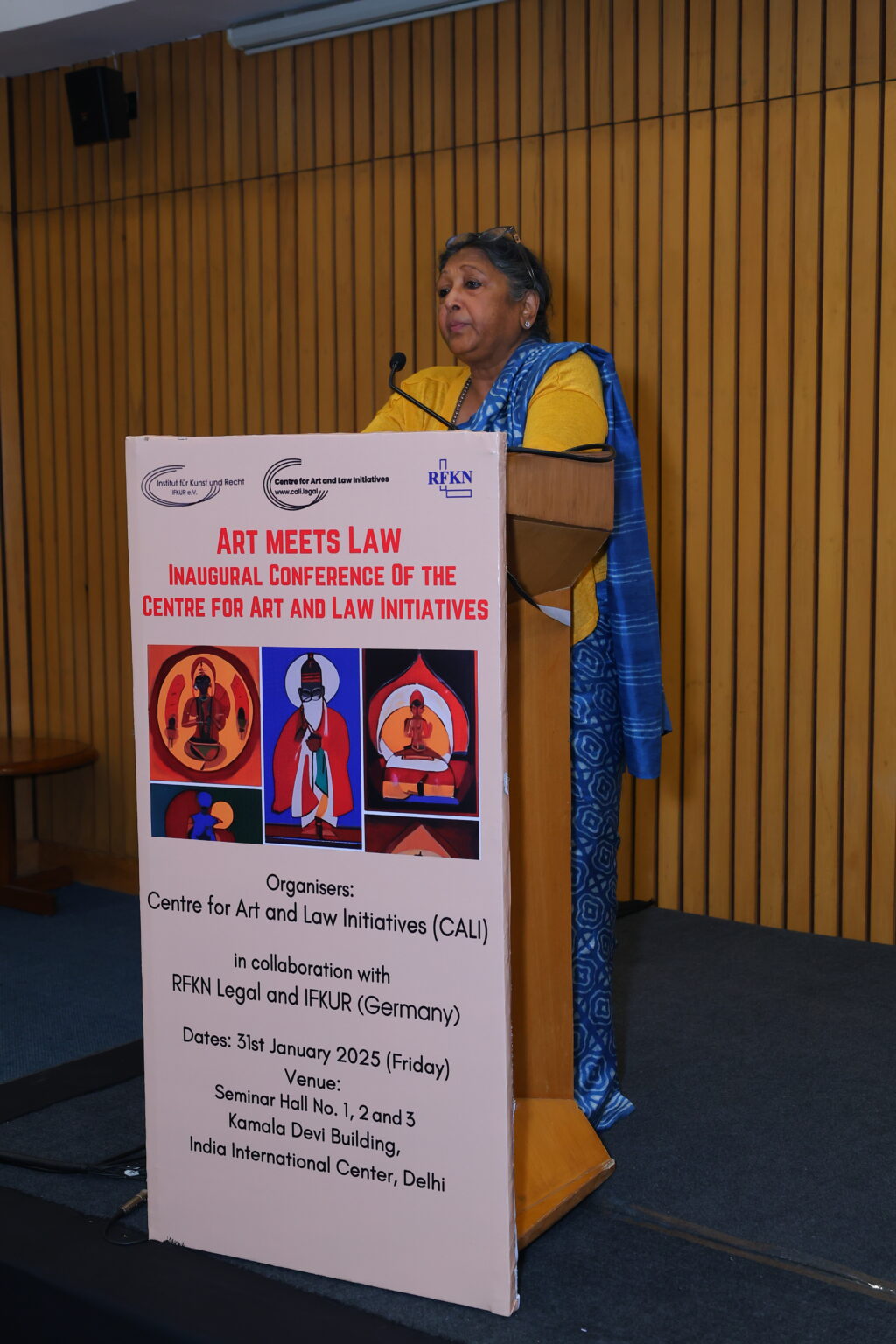
Hon’ble Mrs. Justice Anjana Prakash (Retd.), Senior Advocate
Justice Prakash speech focussed on the statutory framework and judicial landscape governing art theft, copyright infringement, and moral rights in India. She analysed the intersection of the Antiquities and Art Treasures Act of 1972 and the Copyright Act of 1957, tracking how Indian law has evolved to address global piracy and digital creations. To anchor these legal principles, she reviewed several landmark Indian judicial decisions, including Microfibers vs Girdhar regarding the boundaries between copyright and design registration, and MF Hussain vs Raj Kumar Pandey, which addressed artistic expression and the criminal threshold for obscenity. She also examined Amarnath Sehgal vs Union of India to illustrate the protection of an author’s moral rights against mutilation, and Godrej Soaps Private Limited vs Dora Cosmetics regarding trademark reputation.
Justice Prakash highlighted the friction in stretching traditional penal provisions, specifically Section 378 for theft, Section 420 for cheating, and Section 463 for forgery under the Indian Penal Code, 1860 to encompass art-specific misrepresentations. The ultimate hurdle she posed was the complex task of convincing courts to recognize the original author as the direct victim of cheating and reputational harm when their uncopyrighted name or work is illegally exploited.
Mr. Alloys Kemo
Mr. Kemo delivered an expansive critique of the legal, economic, and cultural obstacles that former colonies face when reclaiming their looted cultural heritage. He highlighted institutional barriers such as sovereign immunity, which shields Western museums from lawsuits, and the strict deadlines imposed by statutes of limitations that bar historical claims. To demonstrate these struggles, he presented multiple case studies, including the Pokomo people’s ongoing fight for the sacred Ngadji drum and Nigeria’s multi-year negotiations for the Benin bronzes. He also analysed the landmark U.S. Supreme Court case Republic of Austria v. Altmann (2004), which allowed the retroactive application of the Foreign Sovereign Immunities Act to recover Nazi-looted Gustav Klimt paintings, using it as a blueprint for how substantive legal frameworks can override procedural technicalities.
Mr. Kemo challenged the patronizing justifications used by European institutions to retain stolen goods. He rejected the argument that Western museums are better equipped to preserve artifacts, asserting that African institutions are rapidly advancing conservation capabilities and that preservation should never justify illegal retention. Furthermore, he attacked the legal concept of “good faith acquisition,” arguing that the innocence of a buyer must never outweigh the rights of the original, true owner. Moving forward, Mr. Kemo called on origin nations to actively modernize their own legislations, mandate community involvement, and embrace open-access digital databases, such as Kenya’s Invisible Inventories Initiative, to challenge the power imbalances of diplomatic negotiations.
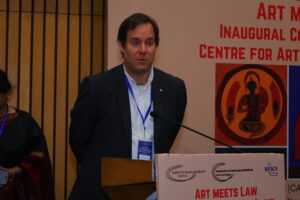
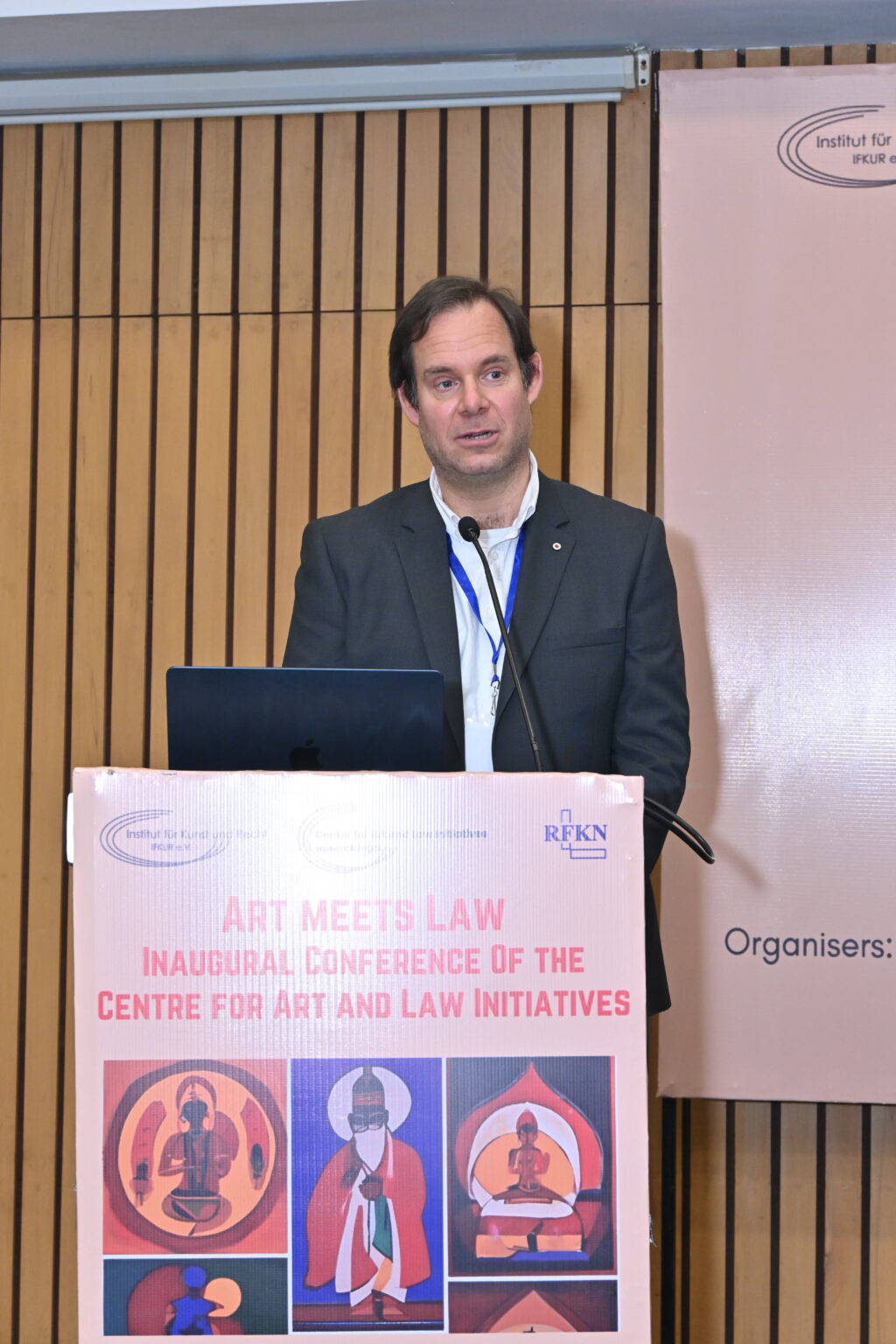
Dr. Nicolai Kemle, Director, IFKuR
Dr. Nicolai Kemle’s address explored the commercial dynamics of the global art market and the increasing impact of European legal frameworks on artwork valuation. He highlighted that while the ultra-high-end market has plateaued, the mid-tier market (between USD 10,000 and USD 500,000) is growing rapidly, with a significant commercial shift toward South Asia and India. Dr. Kemle utilised the unique case of a German carpet, which escalated in value from EUR 1,000 to EUR 7 million due to intense emotional repatriation bidding, to demonstrate why art defies standard banking investment funds. He explained that art valuation relies heavily on volatile, unquantifiable human emotions, alongside measurable criteria such as the artist’s name, physical condition, museum exhibition history, and historical provenance.
The core point of contention that Dr. Kemle raised was how heavy state regulations and environmental laws can slow down and over-complicate the commercial art market. He noted that strict European import/export licensing and anti-money laundering due diligence drastically reduced an artwork’s liquidity and value, sometimes dropping it to zero if it possessed problematic Nazi-era or colonial provenance. He advocated for a paradigm shift toward out-of-court arbitration clauses and structuring contracts around a work’s capacity for public museum display rather than trying to definitively prove originality.
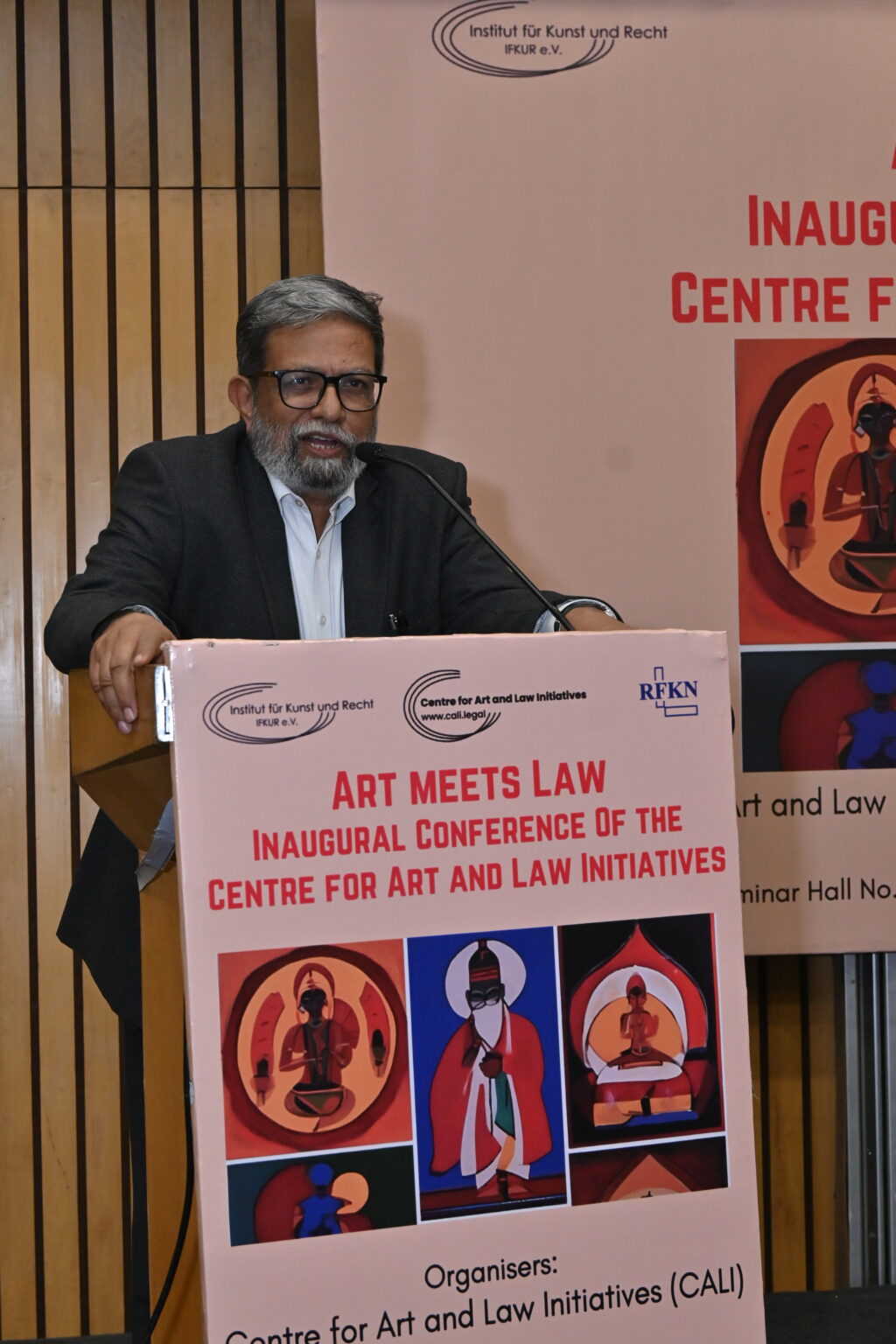
Senior Advocate Mr. N. Hariharan
Mr. Hariharan’s speech centred on the legal, ethical, and technological challenges surrounding art fakes and forgeries. He used high-profile case studies to ground his arguments, including the 2009 Dhoomimal Gallery exhibition where the artist S.H. Raza discovered 33 forged paintings of his own work, and the Millet forgery case from 18th-century France. He spent a significant portion of his address detailing the life of Vincent van Gogh, analysing how the artist’s letters serve as crucial source materials for authentication today, and how a prominent Van Gogh fake ended up in a Japanese insurance company’s collection. He also explained how modern scientific advancements, such as X-ray fluorescence spectroscopy, carbon dating (C-14 isotopes), and infrared refractography, are utilized to detect historical counterfeits and forgeries, citing instances involving Raja Ravi Varma and Leonardo da Vinci.
From a legal standpoint, Mr. Hariharan mapped art forgery onto traditional criminal law provisions, specifically utilizing the Indian Penal Code framework (Sections 464 for false documents, 420 for cheating, and 28 for counterfeiting). However, he raised several critical points of contention for future deliberation, highlighting the acute lack of standardized legal forums or objective benchmarks to determine artistic authenticity. He emphasised that legal trials still rely on opinion evidence, which carries persuasive rather than conclusive value. Furthermore, he challenged the audience with complex legal conundrums, such as the hurdle of statutory limitation periods when a fake is discovered decades later, the absence of criminal intent when a forged work passes through innocent inheritance, and the impending legal chaos brought by artificial intelligence generating untraceable fakes via the darknet.
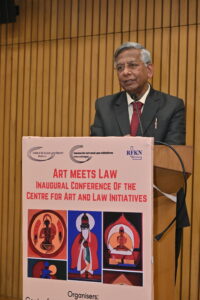
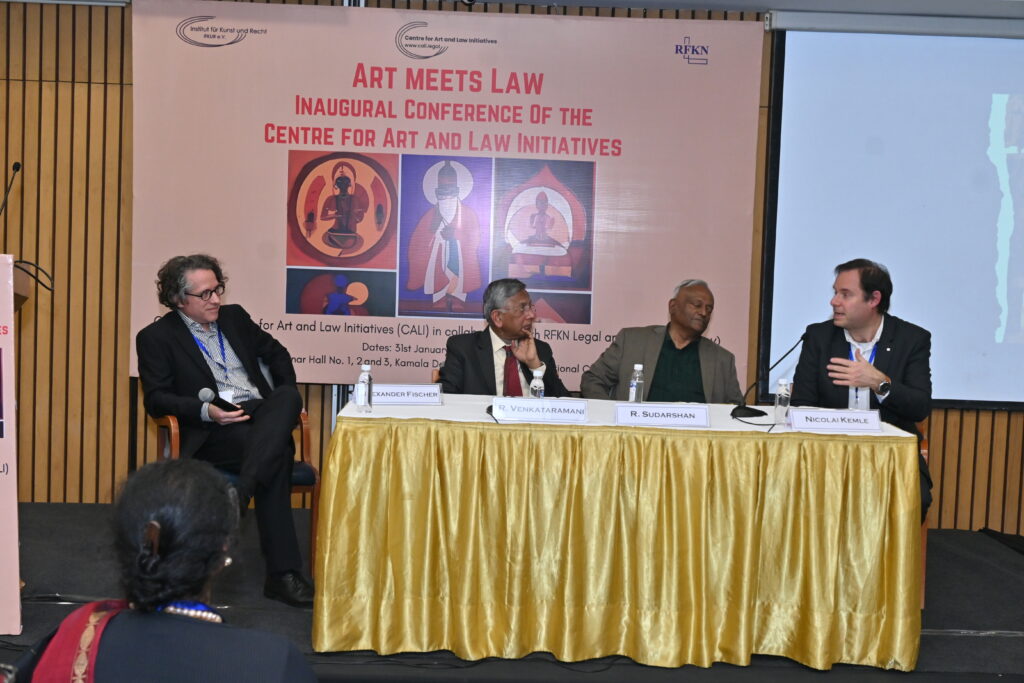
Mr. R. Venkataramani, Attorney General for India
Attorney General R. Venkataramani addressed the systemic obsolescence of current legal regimes governing cultural property. He argued that the international art market, valued at tens of billions of dollars, functions largely to serve the elite, with major auction houses acting as insulated havens shielded by complex “no liability” contractual clauses. Citing international frameworks like the 1970 UNESCO Convention, he contrasted global repatriation efforts with India’s outdated domestic framework, specifically the Antiquities and Art Treasures Act of 1972. He reflected on the failure of a 2019 private member’s bill intended to overhaul this law, pointing out that India remains legally stuck in an era that inadvertently permits the exploitation of its cultural wealth.
Mr. Venkataramani highlighted the urgent need for a fundamental paradigm shift: establishing a mandatory, “involuntary” global and domestic “standard of care”. He argued that the law must stop treating art merely as a commercial commodity or transaction wrapped in property disputes. Instead, law must accommodate the invaluable dimensions of civilizational memory, culture, and history. He proposed that major auction houses and museums must be legally transformed from profit-driven commercial spaces into active restitution agents. Ultimately, he called for the formulation of a new legislative manuscript for the Indian Parliament to debate and enact, moving past outmoded legal fictions to protect sacred civilizational treasures.